Wednesday, March 23, 2011

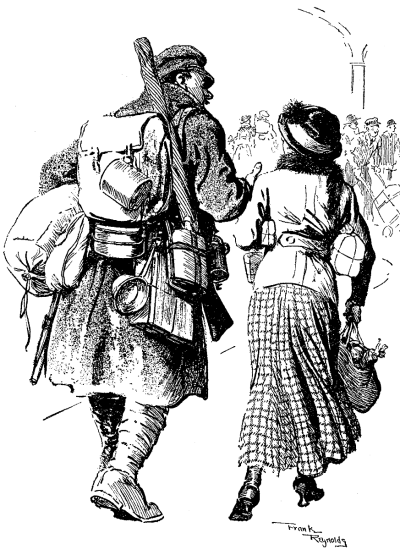
WWI Cartoon

"I say, old girl, do let me carry something."

This World War I cartoon depicts a British solider with a heavy pack on his back, and a helpful gesture to a woman.  Although, many cartoons of the time were negative, and used to emphasize the flaws of the troops in the war, this one is positive.  What you are to get from this picture is that even though the solider is overloaded with equipment, he still wants to help and serve others at his expense.  It shows you the self-sacrifice of the British soliders, and how they are not brutes like their counterparts the Germans.  This is to show those not present on the war how great these soliders are.

American Women during WWI

During World War I so many men left to fight that there wasn't nearly enough to keep factories functioning, so the government turned to the women.  Women went from being the home makers to truck driver's, building tanks, plowing fields, and thousands of other jobs they were never thought capable of doing.  This greatly affected their lives, not only were they making money, but they were realizing that they could do so much more than cook and clean.  World War I also marks the first time women were able to enlist in the military, granted they were mostly nurses, but this was a great opportunity to show their strength.  Nearly 13,000 women enlisted in the Navy and the Marine Corps.  Even thought when the war ended the women went back to their previous lives, their achievements did not go unnoticed.  Many began to realize that they had severely underestimated the capabilities of women, and this was another push on their goal of equal rights.

The Armenian Genocide


Armenia was once a great people with rich history, but the views of three young men changed it all. 
     The 'Young Turks' started out as junior officers in the Turkish army that wanted to guarantee basic rights, create a constitutional government, and simply improve the country as a whole.  These goals were greatly received by the Armenians in Turkey and all seemed well.  However, in 1913 three of the young turks took control of the government by a coup.  The three were Mehmed Talaat, Ismail Enver, and Ahmed Djemal.  Their goal was to unite all of the Turkic people, expand the borders of Turkey, and create a new Turkic Empire, Turan, with one religion, and one language.  But where does this leave the Armenians?  In 1914 when World War I broke out it was seen as the perfect opportunity to take care of the Armenians.  The Turks first disarmed the entire Armenian population, including some forty thousand fighting in the Turkish army.  Next, the decision was made to eliminate the entire population, by the 'Young Turks', and armed round ups began on April 24, 1915.  Men were hung, shot, jailed, tortured, and sometimes bayoneted by death squads.  Then the women, children, and elderly were told they were moving to non-military zones for their safety, but they were really death marches to the Syrian Desert.  In the end between one and two million Armenians were killed, nearly the entire population.
     After learning about this occurrence in history, I am truly disgusted.  To think that the history of an entire group of people is gone, no art, holy cities, nothing.  What bothers me the most about this whole ordeal is that the rest of the world just let this happen. Yes, the world was at war, but to ignore the complete devastation of a race is unacceptable.  They knew that children were being massacred, and that must have meant nothing to them.  This just reinforces how horrible a genocide is.

Tuesday, March 22, 2011

Woodrow Wilson's Fourteen Points

     President Woodrow Wilson proposed fourteen points with the hope of creating peace for the world.  One of his points was the free navigation of all seas, meaning that anyone could navigate the seas of the world without consequence.  Today, that ability no longer exists.  Like with certain airspaces, parts of the sea are run by different countries, and in order to navigate these areas permission must be obtained.  If this is violated consequences will ensue, in some cases ships have been destroyed because they may have been dangerous.  Sometimes in tense situations a warning is issued to keep distance from parts of the sea.
     Another one of Wilson's points was to reduce the number of weapons each country has, but that never took place.  Today there are gun laws, but there is no restriction on how many weapons can be produced and owned by a country.  Each country looks at the ownership of weapons a different way, but no country has reduced their number of weapons.  Overall, countries have in fact increased the number of weapons they posses. 
     Wilson also added a point that said France should be liberated, and recover Alsace-Lorraine, this was a little more successful.  At first, France regained Alsace-Lorraine, but during WWII Germany was able to recapture it.  Today Alsace-Lorraine is back under the control of France.  Also, as Wilson wanted, France is now fully liberated. 
     Wilson also wanted a League of Nations to be set up to help the independence of all states, and ensure that war would not break out.  Although this was a great plan it had many flaws, one was that although it existed both Germany and Russia could not participate.  This was a huge problem because they both held a large amount of power, and were clearly going to do whatever they desired.  Another flaw was the President Wilson could not even get his own country to join the league, greatly hurting his image.  Today the League of Nations has been replaced by a similar and more affective United Nations.
     I think of all of Wilsons points the League of Nations would have been the most successful of preventing war.  Although I previously pointed out some of the flaws in this point, I believe that if this idea had been carried out in a different way it could have been very successful.  The idea was to unite all countries so they could all play a role in the decisions of the world.  If one point could prevent war it would be this one.